"The first man who, having fenced in a piece of land, said 'This is mine', and found people naïve enough to believe him, that man was the true founder of civil society. From how many crimes, wars, and murders, from how many horrors and misfortunes might not any one have saved mankind, by pulling up the stakes, or filling up the ditch, and crying to his fellows: Beware of listening to this impostor; you are undone if you once forget that the fruits of the earth belong to us all, and the earth itself to nobody."
Saturday, December 2, 2017
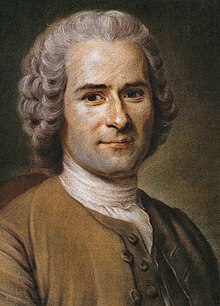
Jean-Jacques Rousseau
We brought up Jean-Jacques Rousseau in class, so I thought I would give a little more detail about his philosophies. Like Voltaire, Rousseau saw nature as a guiding force. He believed that the pure "state of nature" held "uncorrupted morals." Furthermore, Rousseau believed that there were three stages of human development. The first stage was infancy (birth to 2 years old) in which a person has little power and does things for themselves. The second stage was the "age of Nature" from about 2 years old to 10/12 years old in which a person only receives a "negative education." In this stage of life, people develop physical qualities and senses but do not develop their minds. The third stage of life, the stage of the "noble savage," from ages 12-15 is the time in which people are between the two extremes of being animalistic and civilized. The fourth stage, from ages 15-20, is when people begin to use their minds and develop intellectually. The fifth and final stage occurs during adulthood and marks the time in which people mature, find love, and return to society. Aside from his theories on human development, Rousseau also held strong views regarding worldly possessions:
"The first man who, having fenced in a piece of land, said 'This is mine', and found people naïve enough to believe him, that man was the true founder of civil society. From how many crimes, wars, and murders, from how many horrors and misfortunes might not any one have saved mankind, by pulling up the stakes, or filling up the ditch, and crying to his fellows: Beware of listening to this impostor; you are undone if you once forget that the fruits of the earth belong to us all, and the earth itself to nobody."
Lisbon Earthquake in 1755
In 1755 Lisbon experiences an earthquake that is referenced in Voltaire's Candide. This earthquake happened Saturday, November 1st, or all Saint's Day, in 1755 around 10 in the morning local time. The earthquake caused subsequent fires and tsunamis that demolished Lisbon and the surrounding areas in Portugal. Experts today say that the earthquake would have measure from an 8.5-9.0 on the Richter Scale. Estimates for the total death toll in Lisbon alone range from 10,000 to 100,000 people. This is obviously a very large range as it is difficult to calculate with precision the exact death toll from an event that happened in the mid-1700s. The earthquake reported lasted around three and a half minutes, causing 15 feet holes in the city center. Later that same day, a tsunami rushed up the Tagus river and engulfed the entire port and surrounding area. Shocks from the earthquake were felt in South Africa, Finland, Greenland, and the Caribbean. Tsunamis as high as 20 meters tall rose up on the North African coast. Experts say that this earthquake destroyed over 85% of Lisbon's buildings and structures. As we can see the earthquake that was mentioned by Voltaire was a very real event that had very dire consequences.
Favorite Shakespearean Play
As we finish up our discussions on Hamlet and take our assessment, I wanted to get your takes on your favorite play written by Shakespeare. Shakespeare wrote numerous tragedies, comedies, and historical plays throughout his years. We have read each year since 7th grade, I believe, and his works have been some of the most influential works in human history. He has many great plays to choose from, and I was wondering which one was your favorite. One of my favorites was Julius Caesar that we read in 9th grade. It was interesting to me because it was Shakespeare's depict on how he viewed the death of one of the most famous people in human history. We had learned about Caesar in Latin around the same time we read this play, so that made it even more interesting. I also enjoyed A Mid-Summer Night's Dream. I read this play in 7th grade for English class, and to my knowledge was the only comedy we ever read by Shakespeare. I enjoyed it because it was different than what you might expect from a normal Shakespearean play. So what was your favorite play written by Shakespeare and why?
Voltaire Famous Quotes
I was looking up interesting facts about Voltaire, and I found some pretty notable quotes from him. A lot of them provide insight into Voltaire's views and corroborate with some our readings.
1) I disapprove of what you say, but will defend to the death your right to say it.
2) Judge of a man by his questions rather than by his answers.
3) Every man is guilty of all the good he did not do.
4) Illusion is the first of all pleasures.
5) God gave us the gift of life; it is up to us to give ourselves the gift of living well.
6) Optimism is the madness of insisting that all is well when we are miserable.
7) Faith consists in believing when it is beyond the power of reason to believe.
8) Man is free at the moment he wishes to be.
9) When it is a question of money, everybody is of the same religion.
10) It is forbidden to kill; therefore all murderers are punished unless they kill in large numbers and to the sound of trumpets.
These quotes show how Voltaire felt about war/violence, freedom of speech, optimism, reason, and money.
J.K. Rowling: A Leaf Out of Voltaire's Book
Okay, so, yeah, Voltaire probably wasn't the one who invented using not-so-sly pun names for his characters. However, I couldn't help but make this connection, especially because so far I really like Candide, Harry Potter, and etymology. Both authors used similar meanings for the names of two of their main characters.
Candide—"pure, innocent, white." As we've discussed, Candide is certainly naive...to the point of being annoying. He won't ever tell a "white" (get it?) lie to save Cunégonde from the governor! In fact, he doesn't even suspect that the governor is kind of shady. Sigh. The name is also ironic because, hello! Candide is not completely innocent, and definitely would not be thought of as such by today's standards. Up to chapter 15, he'd already murdered three people and yet still claims to be the best of all men (narcissistic much?).
Albus—"white." Albus Percival Wulfric Brian Dumbledore was the headmaster of Hogwarts in the Harry Potter series, known by his trademark half-moon specs and his long white beard. Although initially Dumbledore does indeed seem to be totally wise and a champion of the greater good, a lot of readers now condemn him for using Harry (beginning at age 11) as a tool and for manipulating him and basically sending him to his death, etc. People literally write articles with titles like "Why Albus Dumbledore Sucks" and have many, many, many angry posts on Tumblr about the matter. A lot of people claim that he, directly or indirectly, causes many unnecessary deaths.
I found it interesting that in both cases, there's more to the characters than just being innocent and great human beings (as in real life, of course) even though their names might be misleading on first glance.
Saint Cunigunde of Luxembourg
Saint Cunigunde of Luxembourg/Cunegundes/Cunegunda/Cunegonda/Cunegundis/Kinigundis (yes, she had a lot of alternate names) may have been the inspiration for the character Cunégonde in Voltaire's Candide.
She was Empress of the Holy Roman Empire, having married Emperor Saint Henry II, and also served as regent after her husband's death (1024).
I found it rather ironic to learn of a rumor that she actually wanted to be a nun. Apparently she and Henry agreed to never consummate their marriage. She even made a vow of virginity before they married (with Henry's approval). There is some scholarly debate surrounding the claim, although it is true that they never had children.
Of course, in the true spirit of Voltaire, Cunégonde's name is probably also a crude pun in French and Latin. In addition to that, in Persian the word "gonde" means "big" or "huge" and is quite an impolite term. But who would expect anything less from Candide's author?
#VoltaireIsNotImpressed
So remember the when McKayla Maroney placed 2nd in the 2012 Olympics vault final, instead of 1st, and there was that picture of her on the award stand that became super famous?
I feel like her face really captures Voltaire’s attitude toward many French institutions after he went off to Great Britain in exile. (Not to compare McKayla Maroney and Voltaire. Obviously, McKayla Maroney is way better.)
In 1734, Voltaire published Letters Concerning the English Nation, which basically praised British institutions such as freedom of speech (more on that later). The work was released without the approval of royal censor, and the book was publicly burnt (ironic, considering what Voltaire was expressing in the work), and Voltaire had to leave France AGAIN. At this point, Voltaire was SUPER not impressed with France. He started criticizing intolerance, the Bible, established religion (including Roman Catholicism), and he advocated for separation of church and state and for religious freedom. He also wanted France to be more like the British in order to enable freedom of speech and thought (needless to say, he greatly disapproved of censorship laws in France at the time). Oh, yeah, and he wanted to get rid of absolutism and bring in a constitutional monarchy, which I guess the kings of France didn’t really agree with because Louis XV banned Voltaire from Paris.
Voltaire was honestly kind of hypocritical though, because he was pretty harsh on Islam and Judaism and black people. So…there’s that. But I’ll go more into that in my presentation on Voltaire.
So overall, I would say Voltaire was not impressed.
Subscribe to:
Posts (Atom)