Saturday, August 25, 2018

Genesis Rewritten

The Genesis references we talked about in class in relation to the way the beginning of the novel describes Macondo got me thinking about how exactly the book treats the figures of the serpent, Adam, and Eve and how knowledge (and technology) eventually become the downfall of the people of Macondo. In "rewriting" the chapter of Genesis that deals with the fall of Adam and Eve, I realized that in Macondo, Jose Arcadio Buendia would be comparable to Eve, an interesting twist on the Bible's portrayal of woman committing the first sin. Instead of a woman catalyzing the downfall of Macondo, it is a man--and the founder of the town at that.
I used this website to help me follow the tale of Adam and Eve, and of course, adapted Marquez's story to fit the story in Genesis. 
https://www.biblegateway.com/passage/?search=Genesis+2%3A4-3%3A24&version=NIV 


Genesis, Book 3

The Fall

3 Now the gypsies were more crafty than any people who had ever visited Macondo before. As they went around town demonstrating the connective power of their magical metal ingots, one named Melquiades said to Ursula, “Do you want to buy some for yourself in exchange for some of your livestock?”

2 Ursula said to Melquiades, “We may invite you into our town to show us your wares, but we need our livestock to survive, or we will die.”

4 “You will not certainly die,” Melquiades said to Ursula. 5 “For I know that when you buy the ingots, your eyes will be opened to the outside world, and you will be the most powerful woman in Macondo.”

6 When the woman's husband, Jose Arcadio Buendia, saw that the metal ingots were pleasing to the eye, and also desirable for finding gold, he took some and gave Melquiades a mule and a pair of goats. He told his wife, who was with him, that it would help them discover gold and become rich. 7 He now had knowledge of the outside world. He went off in search for gold, only to find an old suit of armor with a skeleton inside.

8 One day, the gypsies returned, and Jose Arcadio Buendia traded the metal ingots and three of his wife's colonial coins for a magnifying glass. He burned himself and almost set their house on fire in attempts to prove its power as a weapon. Ursula wept and asked why he had traded her coins for a glass that could be used for nothing. 

10 He answered, “When Melquiades returns, I will trade it for something that can be used. One day, I will discover something new for Macondo."

11 And she said, “Who told you that Macondo was not already good enough? Have you been listening to Melquiades's tales of the greatness of the outside world?”

12 Jose Arcadio Buendia said, “The gypsies that came to town—they told me he has great powers and news of the world. I have to discover it for myself.”
Years passed, and Jose Arcadio Buendia became more and more distant from his family and more and more engrossed in his alchemic experiments in his lab. He began to speak Latin to himself and rejected the LORD God. 

13 Then Ursula said to her husband, “What is this you have done?”
Jose Arcadio Buendia said, “Melquiades offered me an opportunity, and I took it.”

14 So Ursula said to her husband of Melquiades, “Because you have done this,
“Cursed is he among all other traders of this earth!
He will travel the world 
   with Death at his heels.
He will contract pellagra in Persia,
   scurvy in the Malayan archipelago,
   leprosy in Alexandria, beriberi in Japan, 
   and bubonic plague in Madagascar.
He will experience an earthquake in Sicily
  and a shipwreck in the Strait of Magellan."


16 To her wicked husband, she said, “Because you listened to Melquiades and traded away our things about which I commanded you, ‘You must not give these away,’
“Cursed is the ground of Macondo because of you;
    through painful toil you will eat food from it
    all the days of your life.

18 A plague of insomnia will ravish the people of our town
   and drive mad and helpless our neighbors.
19 More outsiders will come to our village 
   bringing money and technology and sin.
Innocents will die at the hands of foreign gunfire,
  and their deaths will be forgotten by all. 
And you will eat your food by someone else's hand
until you return to the ground,
    since from it you were taken;
for dust you are
    and to dust you will return.”
22 And Ursula said, “This man, my husband, has been cursed with knowledge. He must not be allowed to bring his insanity into my house again.” 23 So Ursula banished him from the streets of Macondo, which he had been built. 24 After she drove him out, she tied him to a chestnut tree to live out the rest of his days and prevent further damage by his hand to her town of Macondo.

Magical Realism in Pop Culture

While reading "One Hundred Years of Solitude", one of the most prominent things that stood out to me was the way Marquez narrated bizarre events with such a normal tone. As a reader I was really intrigued by this "magical realism", as Marquez makes the most insane situations seem almost normal.  It also made me think of how this story-telling technique is used even in modern media, and how this media uses magical realism to convey the same points made in 100 Years of Solitude. Take the U.S. TV show "Shameless". Similar to 100 Years, Shameless is centered around a family and the events that they experience. The show also delves into certain subjects that are considered taboo, such as teen pregnancy, drugs, and prostitution, and addresses them in such a way that they seem normal after a while. Much like the Buendias family, the Gallaghers never fail to fall to their own vices, and always end up in solitude with themselves. But what magical realism does in Shameless and 100 Years is add drama and emotion to events in order to make them seem real. In Shameless, the show's alcoholic patriarch Frank, after ruining his daughter's wedding day by declaring the truth that her fiancee had been using again, gets thrown into the freezing Chicago River by his other family members and left to drown. While in the water, he sees apparitions of his family, and he realizes the things that he's done and for once in his life, feels guilty. I find this similar to the way Ursula started seeing the ghost of her husband in 100 Years of Solitude. I think that Marquez and magical realism definitely inspired modern writers to use this tone to convey their stories, as it serves as a way to downplay spectacular moments yet make them even more emotionally empowering.

Flooding Coincidence

        I am not sure if this constitutes as a blog post but the instructions seemed rather free-spirited and  open to creativity. A few weeks ago, I was listening to the audiobook version of One Hundred Years while running on a cool (by Louisiana’s standards) summer evening in some quiet woods miles away from any cars or other people. I was truly in absolute solitude like the early days of Macondo when I began to feel a faint drop of rain then suddenly a downpour erupted. While trudging through the storm, I was coincidentally listening to the part of the book when the endless rain began and eventually destroyed Macondo. Although I do not identify much with Aureliano Segundo or any of the other characters affected by the rain at all, the combination of Gabriel Garcia Marquez’s vivid description of the storm and me actually running through a storm made me feel an intimate connection with the characters and the moment in the story.

That's So Raven to Ursula

In One Hundred Years of Solitude, by Gabriel Garcia Marquez, Ursula is paranoid at the thought of the consequences inflicted by incest. She worries of things such as a child born with a pig tail and their family's demise. She does as much as she can to prevent incest from happening in the rest of her family. She does things like wearing a chastity belt and warning her other family members. She refuses to consummate her marriage because Jose Arcadio Buendia is her cousin and she marries him. Eventually they have children, however she continues to warn her family members and attempt to prevent the concept of incest from happening throughout her family. After years and years of generations, her Aureliano Segundo has a baby with his relative who has a pig tail. The fall of the Buendia family comes and all of the work Ursula ever put in to save her family was for nothing. This can be related to the classic sitcom "That's So Raven." In the show, Raven, a psychic teenage girl, gets visions of bad things happening to the ones she loves and herself. Throughout the course of each episode she does everything in her ability to prevent the situation she had seen take place. By the end of each episode, no matter what Raven did to prevent her visions from coming true, they would happen. This parallel between a classic novel's theme and a modern tv show's theme proves to show that no matter what time period we are in, no one has a say in what happens concerning fate. No matter how hard you try, you can't change the things that are meant to happen.

The Concept of Time in 100 Years of Solitude


In Gabriel Garcia Marquez’s 100 years of solitude, the concept of time is skewed throughout the course of the novel. The sense of time is well represented in the first sentence of the novel, “Many years later, as he faced the firing squad, Colonel Aureliano Buendía was to remember that distant afternoon when his father took him to discover ice.” This sentence goes into the future while looking into the past at the same time. As the reader later finds out, the people use machines before they “discovered” ice. Which, in itself is a contradiction of a traditional linear timeline. 

The concept of time also ties into the style of magical realism by blurring the line of reality and fantasy. By changing pace of the timeline and jumping back and forth from past to present to future, the idea of reality is skewed. As a reader, you might not always know where you are in the story at any given time, and that is intentional on Marquez’s part. The cyclical timeline of the Buendía family allows for history to repeat itself. And for certain family members to have different traits. For example, the Aurelianos tend to be mentally strong and more reserved, while the Arcadios tend to have more physical strength and are more impulsive. Through these names and the character traits repeated, remembering who is who and who did what can be difficult at times.

Cycles as They Relate to Progress

As I was reading "100 Years Of Solitude", one thing in particular that stuck out to me were the obvious cycles that were fundamental in the progression of Macondo. I noticed a pattern where a dictator would be overthrown by a new, humanitarian revolution, only for the modern ideologies to become corrupted and a new movement was needed. For example, Colonel Aureliano genuinely believed he was doing good; in the early stages of the novel, he liberated the town and became a symbol of revolution. However, as more time passed, he became corrupted and lost his moral compass. This is confirmed when General Moncada, moments before he is to be killed, points out the fact that Aureliano had become subservient to the revolution and as a result had failed to consider the consequences of his actions.
This reminded me of a play I read over summer, "A Raisin in the Sun" by Lorraine Hansberry. At one point, two of the characters (Beneatha and Asagai) get in an argument regarding the nature of progress. Asagai makes a resounding point when Beneatha confronts him about his belief that he can cause change in impoverished Africa. An excerpt reads, "Perhaps the things I believe now for my country will be wrong and outmoded, and I will not understand and do terrible things to have things my way or merely to keep my power. Don't you see that there will be young men and women... to step out of the shadows some evening and slit my then useless throat? Don't you see they have always been there... that they always will be. And that such a thing as my own death will be an advance? They who might kill me even... actually replenish all that I was."
This quote stuck with me to the extent of remembering it while reading of Macondo and the way in which the most recent form of progress always attempted to prevail. Asagai accepts the concept of dying in the name of revolution and is eloquent in describing some of the themes that play out in "100 Years of Solitude". I think keeping this account of participating in progress is thought provoking as we review the events that took place within the novel.

The Great Works of Gabriel Garcia Marquez

Starting out studying law and then jumping into the world of journalism in his early career, Gabriel Garcia Marquez surprised the world when he went on to write the century's most well-known piece of magical realism, One Hundred Years of Solitude. Despite his deep association with the arena of fantastical fiction, Marquez's published works include a plethora of writing styles, literary genres, and subject matter. One Hundred Years may have rocketed Marquez into fame and saved him from bankruptcy, but it is not his only work of art that is of note.


(In chronological order):


The Autumn of the Patriarch (1975) 

Image result for the autumn of the patriarch
This work is what I call "political fiction." In this novel, Marquez satirizes the right-wing dictators of Latin America with his character "the General of the Universe." According to Sameer Rahim, "This leader of a Caribbean island has the time changed on a whim, fathers 5,000 children and fixes it so that he always win the lottery." Although I have not read the novel, it sounds similar to One Hundred Years in that it draws from real Latin American history and uses hyperbole and absurdity to highlight the true problems Marquez's society faced.


Image result for love in the time of cholera


Love in the Time of Cholera (1985)
Marquez dives into the realm of romantic fiction (not surprising, given "love" is in the title). One of his most famous novels, Love in the Time of Cholera is a departure from his more political literature, such as One Hundred Years and The Autumn of the Patriarch, and is based on his parents' love story.


Image result for news of a kidnapping


News of a Kidnapping (1996)
Although he is famous for his works of fiction, Marquez attacks the real-life story of the kidnapping of eight Colombian journalists by the Medellin Cartel with vigor in News of a Kidnapping. Marquez's subject matter comes from firsthand accounts from some of the victims. 

Image result for living to tell the tale


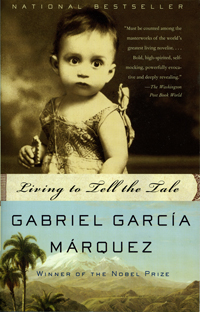
Living to Tell the Tale (2002)
It is not surprising that in the later years of his life, one of the most renowned authors of the twentieth century would decide to write an autobiography. Although Rahim mentions that the lines between reality and fiction may have been blurred for the purpose of entertainment, fans of Marquez were happy to get more insight into Marquez's life from his own perspective. 


Sources:

"Gabriel Garcia Marquez: five essential works" by Sameer Rahim
https://www.telegraph.co.uk/culture/books/10745019/Gabriel-Garcia-Marquez-five-essential-works.html

"The Best Books by Gabriel Garcia Marquez that You Must Read" by Maria Angelica Maia 
https://theculturetrip.com/south-america/colombia/articles/the-best-books-by-gabriel-garcia-marquez-you-must-read/