
Saturday, November 10, 2018
Dante's Version of Hell and Heaven Do Not Seem Very Fair
I don't know about you, but I don't like to think that we live in a world where, if there is indeed a place of blissful afterlife (Paradise, according to Dante), individuals are not admitted due to either not believing in the "right" things on Earth or living in a period before the "right" beliefs became popular. In his "Divine Comedy," Dante paints a Universe where this is unfortunately true. Vergil, a righteous and noble man during his entire life, is not accepted into Paradise due to his lack of belief in God. Given that Vergil lived in the pre-Christian era and accordingly would have had no way of believing in all the requirements necessary to make it into Paradise, this is simply unfair. On the other hand, it's quite vicious to believe that individuals who held other beliefs even when Christianity was popular would not make it into Paradise. Most Hebrews and Muslims went to Limbo. While Limbo is by no means a bad place to be, it's upsetting and even scary to believe that one has to hold the exact correct beliefs to make it into Paradise in a world there is no way to be 100 percent sure of any beliefs.

¿Limbo is Low-key the Place to be?
So obviously paradise (heaven) is the place to be, but besides that, I'm gonna take my chances in Limbo.
Think of all the amazing minds that live in Limbo. Aristotle, Plato, all the various poets. These are all brilliant minds. I think it would be absolutely fascinating to pick their brains for eternity, and then I could give them some knowledge from the future. I could explain all the things that happened over the past 2000 years and these brilliant minds would think of me as a genius. And besides, we would live in a castle, imagine conversing with Plato over dinner while in a castle. That sounds pretty cool to me.
But then again heaven sounds nice too.
Hubris within Epic Poets
In class, we've often pointed out the seemingly narcissistic ways of poets such as Dante as they assert themselves as holy, otherworldly writers, their skill worthy of being used as an instrument of God. As we discussed in class, when Dante says, "I am not Aeneas, I am not Paul", he indirectly draws a parallel between the heroism of these figures and himself as he ultimately does complete the task. Furthermore, in Canto IV, he describes how minds such as Homer, Horace, and Ovid, who are "master singer(s) of sublimest verse", welcomed him into their group of 5. There are multiple other examples throughout the Inferno that support the idea that Dante was prideful.
However, as I was thinking about this in correlation to Milton, I realized that though there is undoubtedly some pride accompanying their incredible capabilities to write, they ultimately attribute their talent to God. The invocation of the muse wouldn't exist if they believed themselves to be all knowing or thought they could rely solely on their talents. The fact that they consider themselves to be translating Gods vision, not their own, inevitably takes away some assumed pride as they aren't indulging in their own creation, but rather in higher ideas. Therefore, though the fact that they often place themselves among the greatest minds ever can be aggravating, remember that they don't accredit everything to themselves!
However, as I was thinking about this in correlation to Milton, I realized that though there is undoubtedly some pride accompanying their incredible capabilities to write, they ultimately attribute their talent to God. The invocation of the muse wouldn't exist if they believed themselves to be all knowing or thought they could rely solely on their talents. The fact that they consider themselves to be translating Gods vision, not their own, inevitably takes away some assumed pride as they aren't indulging in their own creation, but rather in higher ideas. Therefore, though the fact that they often place themselves among the greatest minds ever can be aggravating, remember that they don't accredit everything to themselves!
It's Art Time!: Inferno Style
Without a doubt, Dante's The Divine Comedy is a thought-provoking and inspiring work of literature. The comedy is filled to the brim with illustrative details, and many artists shared their interpretations of descriptions within the play with the world. I'm going to include some of my favorite art pieces on this post, but if you want to see more, you should really check out the sources below!

(might want to find this one on the internet and zoom in!!!)

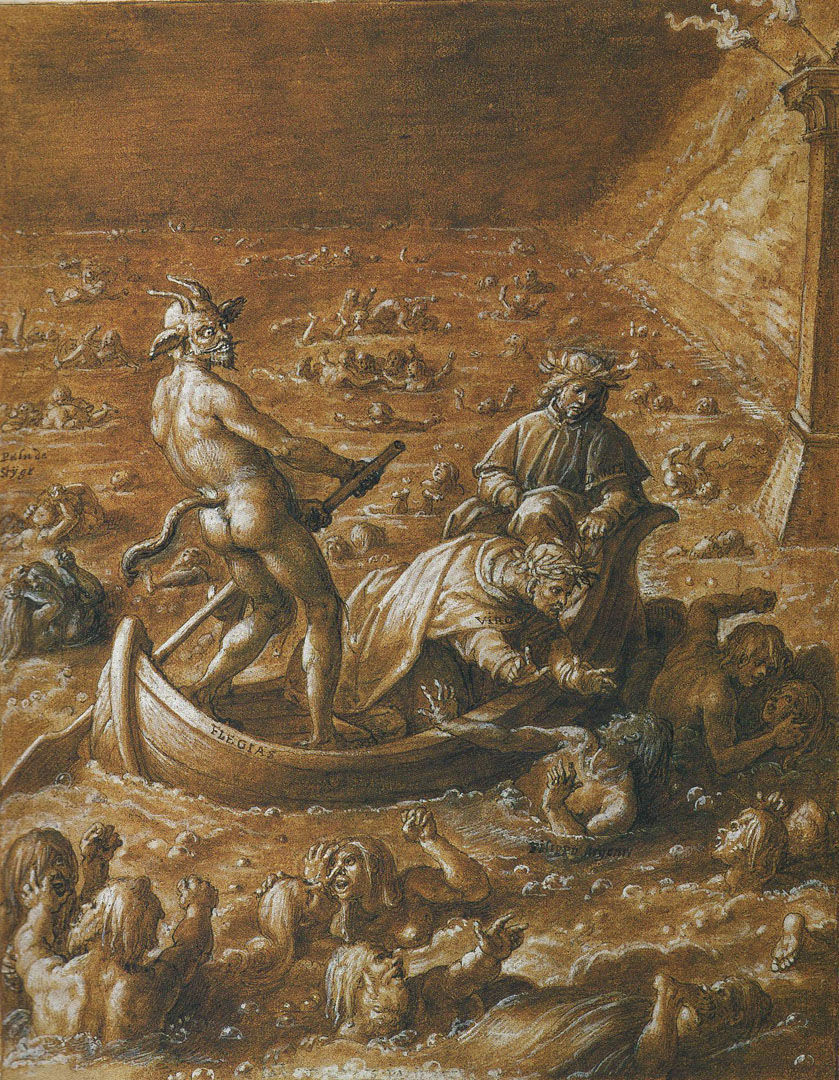
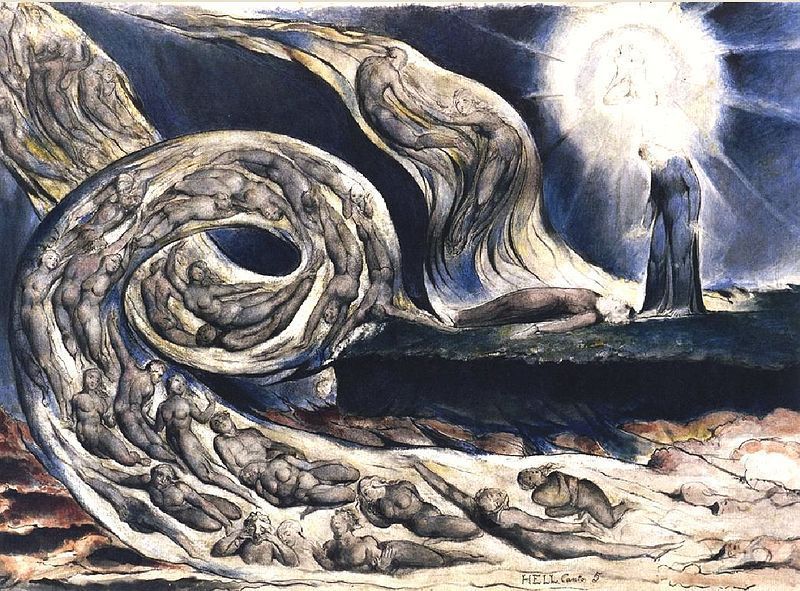
-What the heck is that painting below? "In Canto VII, Dante and Virgil encounter falsifiers, which include alchemists, counterfeiters, perjurers, and imposters. Capocchio, a heretic and alchemist, is attacked and bitten on the neck by Gianni Schicchi, who had usurped the identity of a dead man to fraudulently claim his inheritance." Hmmm...I can't comment too much on this painting as I haven't read Canto VII quite yet, but it's interesting and disturbing, to say the least.

Sources: https://www.florenceinferno.com/artworks/, https://www.florenceinferno.com/the-map-of-hell/
BOTTICELLI
-Not only was he the author of a commentary on the work, but he also illustrated the Inferno. According to my source, "Botticelli was extremely faithful to Dante's text and was very precise in devoting illustrations to every scene that he considered of utmost interest." You actually might already be familiar with his Map of Hell.
(might want to find this one on the internet and zoom in!!!)
STRANDANUS
-Flemish painter, lived in Florence, led Italian Mannerism, picture below is from Canto 8 (wrathful & slothful being punished, Dante & Virgil cross the river Styx with ferryman Phlegyas)WILLIAM BLAKE
-We've all heard of this guy! ("A Poison Tree," "The Tyger," & "The Lamb"...poetry unit!)
-"In these illustrations, Blake paid close attention to the details of Dante’s poem but also brought his own perspective to some of Dante’s central themes, including sin, guilt, punishment, revenge, and salvation. Blake’s imagery sometimes betrays a critical attitude toward Dante but also coexists with many signs of intellectual sympathy."
WILLIAM BOUGUEREAU
-Realistic paintings, not respected during his lifetime because he rejected the norms: Impressionist and Avant-garde movements-What the heck is that painting below? "In Canto VII, Dante and Virgil encounter falsifiers, which include alchemists, counterfeiters, perjurers, and imposters. Capocchio, a heretic and alchemist, is attacked and bitten on the neck by Gianni Schicchi, who had usurped the identity of a dead man to fraudulently claim his inheritance." Hmmm...I can't comment too much on this painting as I haven't read Canto VII quite yet, but it's interesting and disturbing, to say the least.
Sources: https://www.florenceinferno.com/artworks/, https://www.florenceinferno.com/the-map-of-hell/
Thursday, November 8, 2018
Animal Metaphors in The Inferno
In the very first canto of The Inferno, Dante tries to walk up the hillside in the dark wood, only to be stopped by three predators, a leopard, a lion, and a she-wolf. Dante equates these three animals with the three sections of hell: fraudulence, violence, and incontinence (respectively). I wondered why he chose to represent those sins with those specific animals, and I found an analysis online that seems to make sense.
According to Melanie Barker, the leopard represents fraudulence partially because of its spots. The leopard's pelt hides its true intentions as a predator, similar to how frauds present themselves in a positive light before revealing their "vicious nature." It is more obvious that the lion is equated with violence because lions are usually envisioned as creatures of majesty and savage strength. They use brute force to achieve their place as head of their pride and the top predators of the savannah. Finally, the she-wolf represents incontinence, or immoderation. Apparently, sins of incontinence (especially lust) occur in pairs, such as lust and adultery--Dante is comparing this to how wolves travel in packs. Furthermore, he draws upon the Christian idea of women as sexual temptresses and specifies that the wolf is a she. The three animals are just one example of symbols that contribute to the overall allegorical nature of The Inferno.
One last thought: Maybe Dante chose predators to represent sins because humans are preyed upon by the temptation of sin? What are y'all's thoughts?
Source:
https://www.themystica.com/mystica/articles/d/divine_interpretation_the_%20a_study_of_metaphor_in_dante%27s_inferno.html
Who Was Beatrice?
Dante's literary works glorify a character named Beatrice--and she's not entirely fictional. In his early lyric poetry (The New Life), he writes love songs to her. Beatrice is the one who sends Dante help when he is traveling through Hell and Purgatory, and in the third canticle of The Divine Comedy, she serves as Dante's guide through Paradise. This mysterious character is thought to be based on a real figure from history, Beatrice Portinari, a Florentine noble. According to history, Dante first saw Beatrice at the age of nine, immediately fell in love, and devoted his works ultimately to praising her beauty and kindness. In my opinion, it is a little creepy that Dante kept his nine-year-old crush for the rest of his life, especially considering that she was married. (To put it in perspective, they were the same age, but Dante took it a little too far.) Dante eventually married another noblewoman in an arranged setup organized by his family and had three children; however, he never stopped writing about his true love, Beatrice. I wonder if his wife ever got annoyed with his writing--her husband kept writing about another woman!
Sources:
https://www.britannica.com/biography/Beatrice-Italian-noble
https://en.wikipedia.org/wiki/Dante_Alighieri
Sources:
https://www.britannica.com/biography/Beatrice-Italian-noble
https://en.wikipedia.org/wiki/Dante_Alighieri
Circle of hell- STM Day (im not bashing stm day-read it)
There should be a circle of hell for those students who don't participate in STM Day. This morning I was a part of a conversation about why STM Day is "dumb." WHAT?? St. Martin's Day may be one of the single best things that STM does all year. Forget senior weird day, forget matriculation-- STM Day is fantastic. You get to pick your little buddy whether they're talkative, shy, funny, or weird; it doesn't matter! Then we play games (how could you not love the intense musical chairs) and get hype for the scavenger hunt. Not to mention we don't have school and it's a half day!! And in my opinion, those who just sit around all day waiting for time to pass by, ignoring their buddy, and don't even try to win the scavenger hunt should have their own circle of hell. The punishment should be endless sprinting between the Lowerschool and the Upperschool breezeways as you're taunted by doughnuts, Mr. Nolan's hamburgers, and the Cottage lemonade but can't stop to eat any. How can you hate a day that is solely dedicated to hanging out with cute little kids, eating food, fun competitions, and winning prizes. Maybe that's just the competitor in me talking (especially because my advisory has won every year since freshman year), but I think STM Day is so fun.
Subscribe to:
Posts (Atom)
