
Saturday, November 3, 2018
The Conference and our Readings
On Friday, some of us went to a conference about cancer research, and one of the important things they stressed was knowledge about family history. They talked about this in respect to family histories of cancer and genetics, but it reminded me of the many stories we have read that focus on family background and identity. Knowing information about how your genes impact your likeliness for certain cancers allows for extra precautions to be taken to avoid such cancers. In Oedipus, knowing his true lineage could've possibly changed his story. Also, I think it's pretty cool that with technology we can catch early stages of cancer and have the ability to change someone's "fate" or outcome by curing them.

The Contemplative Life in The Divine Comedy
As I was reading Canto II of Dante’s Inferno, I saw the reference to the biblical figure Rachel towards the end. There was a footnote that explained Rachel represented “the contemplative life” and that fact intrigued me, so I thought I would dig a bit deeper into that.
Rachel is in the Bible along with her sister Leah, both of whom were Jacob’s wives. Leah was his first wife and Rachel was his second. According to Aristotle and further touched upon by Dante, there are two lives: the active and contemplative life. Leah represents the active life while Rachel the contemplative. Dante touches on this overall subject more specifically in Purgatorio:
“We must know, however, that we may have two kinds of happiness in this life, according to two different paths, one good and the other best, which lead us there. One is the active life, the other the contemplative life, and although by the active, as has been said, we may arrive at a happiness that is good, the other leads us to the best happiness and state of bliss, as the Philosopher proves in the tenth book of the Ethics.” (4.17.9)
The contemplative life can be defined as “a lifelong journey to God in prayer and worship, turning from all else that could make the journey less direct” and it consists of monks and nuns “called” to dedicate their entire lives to prayer in solitude. This clearly shows Dante’s commitment and investment in religion and how that was reflected in his strong political views, as we read in the introduction.
In further researching, I came across a figure associated with “contemplative mysticism” and he was Pope Gregory I. His papacy began in 590 AD and ended in 604 AD with his death. He led a busy life but appreciated the lives of the contemplative, thus creating his own theology for elitists to associate their lives with not only Leah but Rachel too. He is referenced in Purgatorio as well.
Hope y’all are as enlightened by this subject as I am now :)
https://poorclarepa.org/what-is-contemplative-life/
http://danteworlds.laits.utexas.edu/textpopup/pur2701.html
https://www.christianitytoday.com/history/2008/november/spirituality-for-busy-people.html
Rachel is in the Bible along with her sister Leah, both of whom were Jacob’s wives. Leah was his first wife and Rachel was his second. According to Aristotle and further touched upon by Dante, there are two lives: the active and contemplative life. Leah represents the active life while Rachel the contemplative. Dante touches on this overall subject more specifically in Purgatorio:
“We must know, however, that we may have two kinds of happiness in this life, according to two different paths, one good and the other best, which lead us there. One is the active life, the other the contemplative life, and although by the active, as has been said, we may arrive at a happiness that is good, the other leads us to the best happiness and state of bliss, as the Philosopher proves in the tenth book of the Ethics.” (4.17.9)
The contemplative life can be defined as “a lifelong journey to God in prayer and worship, turning from all else that could make the journey less direct” and it consists of monks and nuns “called” to dedicate their entire lives to prayer in solitude. This clearly shows Dante’s commitment and investment in religion and how that was reflected in his strong political views, as we read in the introduction.
In further researching, I came across a figure associated with “contemplative mysticism” and he was Pope Gregory I. His papacy began in 590 AD and ended in 604 AD with his death. He led a busy life but appreciated the lives of the contemplative, thus creating his own theology for elitists to associate their lives with not only Leah but Rachel too. He is referenced in Purgatorio as well.
Hope y’all are as enlightened by this subject as I am now :)
https://poorclarepa.org/what-is-contemplative-life/
http://danteworlds.laits.utexas.edu/textpopup/pur2701.html
https://www.christianitytoday.com/history/2008/november/spirituality-for-busy-people.html
Medea and Madea
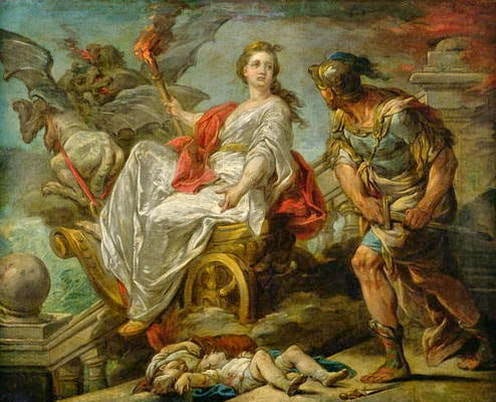

When seeing the title of my blog post you might be thinking to yourself, what could Medea and Madea possibly have in common? Although Tyler Perry's character Madea did not kill her own children, she had her other ways of getting back at the people who harmed her.
Madea also loves revenge, according to Wikipedia, "Vindictive in nature, Madea gets even in a bad way. When asked why she felt the need to get somebody all the time, Madea answered: 'Well when you gettin' got and somebody done got you and you go get them, when you get 'em, everybody's gon' get got.'"
Similar to Medea, Madea has a very extensive criminal record. Madea started at the age of 9 with petty theft, later progressing to identity theft, check fraud, assault, attempted fraud, possession of a handgun, assault with a deadly weapon, and many more. "Madea has a tendency to overreact and is willing to threaten to use deadly weapons, destroy property, use physical violence, take on the law, and use any and all means necessary to show up an offending party. Incorrigible in her overreactive ways, Madea has repeatedly landed herself in court anger management classes, house arrest, and even prison."
Also, Tyler Perry recently announced he is killing off Madea in his newest movie "A Madea Family Funeral."
Sources:
https://en.wikipedia.org/wiki/Madea
Medea Ending: An Easy Way Out?
The ending of “Medea” is often the subject of much controversy (Aristotle even uses the ending as an example of how playwrights should NOT end a play). Euripides concludes “Medea,” by employing a strategy known as “deus ex machina,” or “god from machine.” Essentially, this is a term that refers to critical points in the plot of a story being easily tied up with the invocation of a god. This technique is often looked down upon by many because it is simply deemed “too easy.” It often looks like lazy writing.
Euripides utilizes “deus ex machina” in Medea when Medea, after murdering the Princess of Corinth and her two children, flees Corinth via a chariot of Artemis. Though Medea briefly communicates with Jason after these murders and before she departs from Corinth, all she does is gloat over her killings and predicts Jason’s downfall. In other words, the abrupt ending provides readers with unsatisying answers to several questions they may have been asking themselves throughout the play, such as how Medea will reach Athens and flee Corinth after committing such a heinous crime on the royal family and what is in store for Jason after his family was just murdered. Although the ending does technically tie up the play, it does so in a cheap manner. Rather than receiving an ending that is on par with the level of drama in the rest of the play, readers are presented a conclusion that does little to satisfy their desire for an intense culmination.
Sources:
https://www.google.com/amp/s/titusadelani.wordpress.com/2015/09/02/medea-a-real-ending/amp/
https://www.ancient-literature.com/greece_euripides_medea.html
Euripides utilizes “deus ex machina” in Medea when Medea, after murdering the Princess of Corinth and her two children, flees Corinth via a chariot of Artemis. Though Medea briefly communicates with Jason after these murders and before she departs from Corinth, all she does is gloat over her killings and predicts Jason’s downfall. In other words, the abrupt ending provides readers with unsatisying answers to several questions they may have been asking themselves throughout the play, such as how Medea will reach Athens and flee Corinth after committing such a heinous crime on the royal family and what is in store for Jason after his family was just murdered. Although the ending does technically tie up the play, it does so in a cheap manner. Rather than receiving an ending that is on par with the level of drama in the rest of the play, readers are presented a conclusion that does little to satisfy their desire for an intense culmination.
Sources:
https://www.google.com/amp/s/titusadelani.wordpress.com/2015/09/02/medea-a-real-ending/amp/
https://www.ancient-literature.com/greece_euripides_medea.html
How to Keep Zeus Happy
Keeping Zeus Happy: A How-to Guide
1. Don't break an oath!
2. Probably don't do a lot of other things...there are many myths!
In Medea, oath-breaking (in this case, the oath taken with marriage) is seen as taboo and to say that it was frowned upon would be an understatement. One of the reasons oath-breaking was probably such a serious offense is because ZEUS, Mr. Olympian Extraordinaire, was the keeper of the oaths; and it's probably not the wisest idea to cross Zeus.
I looked into oath-taking in Ancient Greek and found out that when you took an oath, you "called down a conditional curse on [yourself], to take effect if [you] lied or broke [your] promise." In a way, when Jason broke his marital vows to Medea, he also murdered Kreon's daughter and his own children (indirectly, of course). It's also interesting to note that, unknowingly, he directly contributed to Kreon's daughter's death when he extended Medea's gift offer to her.
Jason, just like his fellow "civilized" countrymen, knew that breaking an oath was a major no-no. Still, hungry for power and status, he broke it nonetheless. While I feel bad for the children, Jason got what was coming to him. He got served the ultimate Ancient Greek justice, with a side of burning, poisoned flesh. Yuck! Not my favorite image of the play, honestly...
Source for Zeus and oath stuff: https://en.wikipedia.org/wiki/Horkos
1. Don't break an oath!
2. Probably don't do a lot of other things...there are many myths!
In Medea, oath-breaking (in this case, the oath taken with marriage) is seen as taboo and to say that it was frowned upon would be an understatement. One of the reasons oath-breaking was probably such a serious offense is because ZEUS, Mr. Olympian Extraordinaire, was the keeper of the oaths; and it's probably not the wisest idea to cross Zeus.
I looked into oath-taking in Ancient Greek and found out that when you took an oath, you "called down a conditional curse on [yourself], to take effect if [you] lied or broke [your] promise." In a way, when Jason broke his marital vows to Medea, he also murdered Kreon's daughter and his own children (indirectly, of course). It's also interesting to note that, unknowingly, he directly contributed to Kreon's daughter's death when he extended Medea's gift offer to her.
Jason, just like his fellow "civilized" countrymen, knew that breaking an oath was a major no-no. Still, hungry for power and status, he broke it nonetheless. While I feel bad for the children, Jason got what was coming to him. He got served the ultimate Ancient Greek justice, with a side of burning, poisoned flesh. Yuck! Not my favorite image of the play, honestly...
Source for Zeus and oath stuff: https://en.wikipedia.org/wiki/Horkos
Women in Medea
Euripides, Euripides, Euripides, before I started reading your play Medea, I thought to myself, Yes! Finally a play that features a bad-to-the-bone female heroine. She's going to kick Jason's … !
Well, I have to say, after finishing play, I was slightly disappointed. There's no denying it: the play was intriguing and full of surprises (some violent and bloody, but still). I enjoyed the play as a whole but was disappointed by the way in which Euripides portrayed women. Had I no preconceived expectations, I wouldn't have been quite so put-off, but I expected Euripides to present women in a more positive light.
Ok, should we glorify a woman whose desire for revenge leads her to murder her children? Of course not. So in a way, Euripides does Medea justice. Via the Corinthian women, he expresses his agreement with her taking revenge on her husband for being disloyal and unfaithful but indicates his disagreement with her taking her hatred out on her children. He also points out that society characterizes intellectual women as crafty and ill-intentioned and highlights various struggles women face at the time.
However, his description of Kreon's daughter is just one example of Euripides sticking to societal standards and views of women. Kreon's daughter doesn't accept Medea's gifts to be gracious or kind or sympathetic to her hardships; no--she accepts the gifts because she is vain and seemingly materialistic. In a way, she represents the vanity of women and their blindness in the face of gifts.
My overall point is that although Euripides's Medea features a strong female figure, his views of women are by no means revolutionary or even feministic. I still really enjoyed Medea (it's one my favorite plays now!), but for different reasons.
Dante’s Beasts
In reading Dante’s Inferno, I found the three beasts that he confronted to be particularly interesting. The first beast is the leopard, who Dante views as “all tremor and flow and gaudy pelt.” Though beautiful, this beast is deadly and is capable of seducing people to their demise, as it symbolizes lust. The second animal, the lion, is described as a huge beast, “raging with hunger”, and symbolizes pride. The lion arrogantly lifts its head high, as if to challenge others to question his authority. The final beast, the she-wolf, is described as being the most terrifying by Dante, as she is noted to bring “endless grief.” She symbolizes avarice as she constantly craves more regardless of the pain she causes.
The interpretation I prefer says that the animals represent the three categories of sin: incontinence, violence, and fraud. I’m intrigued by this interpretation as it claims the she-wolf is the most terrifying to Dante because she represents incontinence, the level of hell which we are most susceptible to go to/the level which is hardest to overcome.
Regardless of how you interpret them, the beasts provide an immediate demonstration of the symbolism and descriptive power used by Dante throughout the Divine Comedy.
Subscribe to:
Posts (Atom)

