Thursday, September 28, 2017

Looted Art: Shattered and Scattered

The Parthenon had been greatly abused during the Ottoman rule of Greece. The explosion in 1687 severely damaged the temple and its sculptures. In the 1700s, wealthy European families started to tour Athens and took artifacts with them. From 1800 and 1803, Thomas Bruce, 7th Earl of Elgin removed some of the surviving artifacts with the alleged permission of the Ottoman Empire, which occupied Greece until Greek independence in 1832. These sculptures, known as the Elgin Marbles, were moved to Britain. There, the acquisition of the collection was supported by some, while others, such as Lord Byron, likened the Earl's actions to vandalism. In 1816, he sold the Marbles to the British Museum in London, where they are now displayed. Since 1983, the Greek government has been urging the return of the marbles to Greece.


It is a pity that friezes cannot be joined together where they belong just because of the stubbornness of some museums and countries. Scattered artifacts are like wandering ghosts in search of a final resting place.

Soccer fans do not expect reminders of British colonialism's spoils in an European away game, but that is exactly what happened this week. Tottenham Spurs, a London team, played a Champions League away game against APOEL Nicosia, a team in Cyprus. A section of the fans held up this banner:


Plundered art is a common theme in wars and invasions throughout the history of human civilization. From Alexander the Great and the Valley of the King's tomb robbers to the conquistadors and Napoleon, people just love to steal art from losers of armed conflicts. Some of the best examples of looted art along with the Elgin Marbles are the Louvre's numerous Egyptian antiquities and Nefertiti's Bust in Berlin. The most common reason given by museums and countries that insist on holding on to foreign antiquities is that they can preserve the artifacts better than the country that the things came from. This argument is pure disrespect, and museums like the British Museum should be ashamed of themselves. Antiquities are part of a country's identity, priceless items that reflect a society's past and present. When an artifact is owned by a foreign country, the value is diminished, simply because it does not belong there. I hope all scattered art returns to where it belongs and where it will be most valued.

Wednesday, September 27, 2017

Delphic Trances 101

You know when people in TV shows go into trances?  Their eyes go kind of blank, they start swaying, their voice gets a bit weird...What causes that?

I may never know for sure (having never been hypnotized or anything of the kind myself, thankfully), but science points to a pretty solid hypothesis of what caused this odd trance state at Delphi.

What you need to know about the process:

  • There's something called a Delphi Fault that formed about two million years ago, and it keeps getting bigger
  • Slippage on the fault lines = adjacent rock masses heat up
  • Petrochemicals are vaporized and gases rise
Then, according to science, these gases managed to sneak their way into the adyton where the Pythia sat.

___
Dictionary time:
           Adyton: a restricted area within the cella of a Greek temple, meaning "inaccessible" or "do not enter."  
           Pythia: name of the High Priestess of the Temple of Apollo at Delphi, commonly known as the Oracle of Delphi.  Name is derived from Python, which in myth was the original name of Delphi.
___

Scientists think that these gases may have been the cause of the weird "prophetic trances" that the oracles underwent.  Apparently, there were two kinds of trances typical of the oracle.  One featured a Q&A session during which the oracle's voice sounded really weird, followed by the oracle seeming to be very loose and at ease.  The second kind is somewhat like Chloe described of the bacchantes: some terrifying garbling animal-ish noises here, some body-flailing there.  Sadly, after this type of trance, the oracle usually died (according to Plutarch). 

Scientists think that this gas explanation makes sense because the behavior in both types of trances lines up with the behavior typical of people who have inhaled hydrocarbon gases.

Not the first hypothesis I would have come up with, but I thought this was pretty interesting.


The Modern Chorus

Major developments have been made in theatre since the time of ancient greek drama. The chorus, the other essential actor of the ancient greek tragedy, usually took the role of the public, the people the other than the main characters that have a major say in the way the plot plays out. Im taken back, to about three and a half years ago, when I attended the play: Sheer Madness. The play is a comdeic  murder mystery that takes place in a 70's hair salon and the four main characters are the major suspects. The play is iconic for including the audience in the play; at the end of the play, the audience accuses one of the character to be the murder. Associating this to greek tragedy, the audience, in sheer madness, was the chorus. I see this trend of audience invent become more prevalent in recent broadway hits. The audience is beginning to develop a voice in the theatre.

The Oedipus Complex

I see Oedipus as a man who hold himself on a pedestal. King Oedipus reminds me of one of my close friends; this said friend like to make himself sound like a savior when he does one good deed. Don't get me wrong, my friend has done some honorable deeds, but their ego goes up a considerable amount after completing one of these said task. When first reading Oedipus, I was immediatly  reminded of my friends ego. Oedipus acts like he deserves to be the king because of his solving of the sphinx's riddle. The solving of the riddle is an extraordinary task that cannot simply be answered by a simple bystander, Oedipus is honorable for completing this task, but the man holds himself up on a pedestal. One thing that I personally believe makes a person actually honorable is that when they do a good deed, they don't acknowledge the fact they've done a good deed. To be truly honorable, i see a person should not acknowledge the quantity or the quality of their good deeds, but rather to do good deeds without expecting praise. Oedipus just labels himself as an honorable man, he's just a mother-lover who puts himself on a god-like status because he solved a riddle.

Responsibility

Since we have now finished reading Oedipus Rex, I would like to go back to Tomas' article in The Unbearable Lightness of Being. Tomas claims that the Soviets should act responsibly like Oedipus, who gouges his eyes after realizing what he had done. When the Soviets do something wrong, they just say that it is a mistake. Their attitude is in stark contrast with that of Oedipus, who probably goes too far by choosing oedipism as self-punishment, but at least feels responsible for his actions and their effects on his family and the people of Thebes. Oedipus is a responsible man. With his power and position, he could have dismissed Creon's interpretation of the god's words from Delphi (Creon suggests that it is the murder of Laius that plagues Thebes, even though there is no direct reference to murder in the oracle, just "corruption"). And yes, he follows this interpretation initially because he does not know that the murderer is himself, but he does not need to reveal the truth to the public when he finally realizes what is going on. With Jocasta supporting him, he could have hid the truth, but instead, he tries to verify his beliefs by bringing the shepherd to the palace. He could have even blamed Apollo and his prophecy as a last resort, but he does not do that. I don't know, maybe the fact that he realizes that he married his mother and killed his father leads him to take responsibility and punish himself, but I still think the fact that he feels responsible for the people around him is significant because many of the Soviets do not feel guilt, as Tomas argues.

Oh, The Irony

Oedipus the King is the textbook of the art of irony. Just one of the many instances:

"Now my curse on the murderer. Whoever he is,
a lone man unknown in his crime
or one among many, let that man drag out
his life in agony, step by painful step—
I curse myself as well . . . if by any chance
he proves to be an intimate of our house,
here at my hearth, with my full knowledge,
may the curse I just called down on him strike me!"

Back in ancient Greece, most of the audience were probably already familiar with the outcome of the play. But still, there were probably some who lived under a rock for a while and were watching the play for the first time without any knowledge. I think the difference between the experiences of watching the play with familiarity and without it is tremendous. Most people loathe spoilers, but in the case of Oedipus Rex, I think is it a better watching and reading experience when one already knows the outcome. The dialogues, coupled with Oedipus' stubbornness and impulsiveness, create irony that is humorous and at the same time, satisfies the Aristotelian purpose of tragedy—to evoke pity and fear.


This particular mouse reminds me of Oedipus. First of all, he "just can't see it." Also, like the two meanings of mouse, Oedipus sort of has a double layer. The literal meaning is "swollen foot," which is a clue to his identity and past that he so desires to uncover. On the other hand, Oedipus is also the name of the king of Thebes. The relationship between the two layers represents Oedipus' blindness to truth, which ultimately destroys him.

The Seikilos epitaph: the Oldest Existing Music

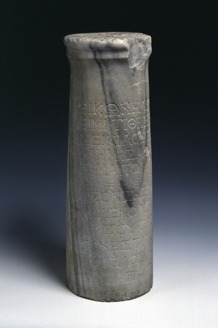
Another interesting piece of Greek music history I came across is the Seikilos epitaph, which is the oldest complete work of music that has survived until today. Probably made around the 1st century AD, but the date is unsure. It comes from a stele found on a grave stone with a poem and musical notation. The poem is dedicated to Euterpe by Seikilos, so one possible interpretation is that Seikilos dedicated this to his wife after she died. Below I have a translation of the poem, some pictures, as well as a video of some modern interpretations, so you can listen to the oldest known song in existence.


Ὅσον ζῇς φαίνουHóson zêis phaínouWhile you live, shine
μηδὲν ὅλως σὺ λυποῦmēdén hólōs sy lypoûhave no grief at all
πρὸς ὀλίγον ἐστὶ τὸ ζῆνpros olígon estí to zênlife exists only for a short while
τὸ τέλος  χρόνος ἀπαιτεῖ.to télos ho chrónos apaiteî.and time demands an end.